

share on
Business restructuring pushed retrenchments higher, particularly in information & communications and manufacturing, while employment continued its 19-quarter growth streak and hiring expectations improved.
Retrenchments in Singapore increased in the second quarter of 2026 after remaining stable over the past few quarters, as businesses in selected outward-oriented sectors underwent restructuring amid ongoing economic uncertainty.
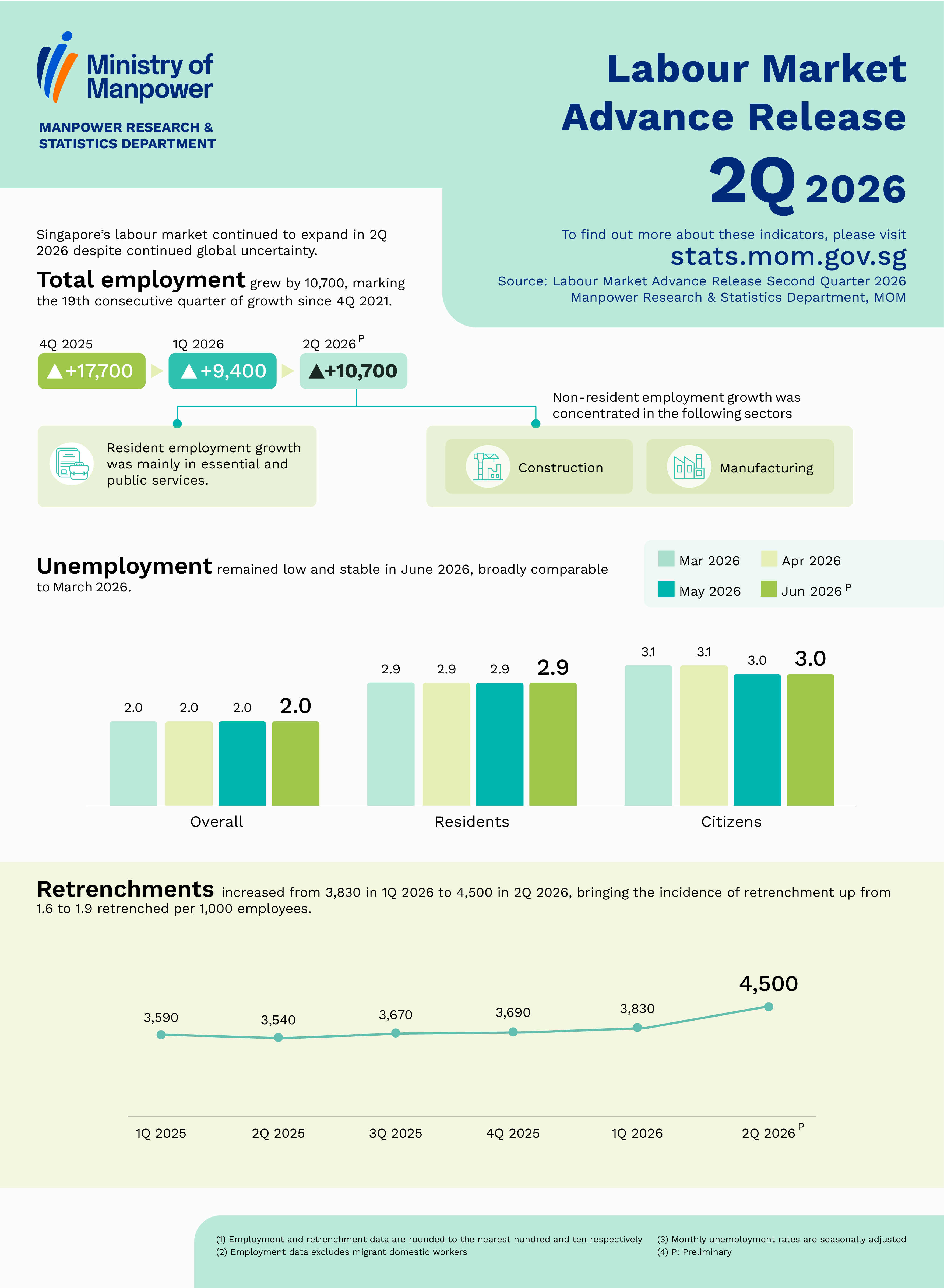
According to advance estimates from the Ministry of Manpower (MOM), the number of retrenchments rose from 3,830 in the first quarter of 2026 to 4,500 in Q2 2026. The incidence of retrenchment also increased from 1.6 to 1.9 retrenched employees per 1,000 workers.
The increase was concentrated in outward-oriented sectors such as information & communications and manufacturing, with the majority of retrenchments driven by business reorganisation or restructuring. Despite the increase, retrenchment levels remained well below those typically seen during periods of economic downturn.
Even as retrenchments rose, Singapore's labour market continued to show resilience. Advance estimates indicated that employment expanded for the 19th consecutive quarter since the fourth quarter of 2021, while unemployment remained low and stable. Labour demand also held up, although employers continued to exercise caution in their hiring and wage decisions amid global economic uncertainty.
Hiring sentiment improves despite cautious outlook
Forward-looking indicators pointed to improving business sentiment in June 2026.
MOM's business expectation polls showed that the share of firms expecting to hire over the next three months increased from 40.6% in May to 43.9% in June. During the same period, the proportion of firms expecting to raise wages rose from 23.7% to 29.3%, while those expecting to retrench declined from 3.2% to 2.7%.
The improvement in hiring and wage expectations was broad-based across sectors. However, these indicators remained below their pre-crisis levels recorded in February, suggesting that employers are likely to remain measured in their hiring and wage decisions in the near term.
Overall, the stronger hiring, wage and retrenchment expectations indicate that labour demand remains resilient, even as firms continue to navigate an uncertain economic environment and ongoing restructuring in selected sectors.
Unemployment remains low and stable
Singapore's unemployment rates remained low and broadly unchanged in June 2026.
The overall unemployment rate held steady at 2.0%, while the resident unemployment rate remained at 2.9%. The citizen unemployment rate edged down slightly from 3.1% in March to 3.0% in June.
Employment growth extends to 19 consecutive quarters
Total employment grew by 10,700 in Q2 2026, an increase from 9,400 in the previous quarter and broadly similar to the 10,400 jobs added in the second quarter of 2025. This marked the 19th consecutive quarter of employment growth since Q4 2021.
Following slower growth in non-resident employment during the first quarter, overall employment growth in Q2 was mainly driven by non-resident workers in the construction and manufacturing sectors.
Meanwhile, resident employment continued to increase, despite at a slower pace than the previous quarter. Growth was concentrated in essential and public services, particularly transportation & storage, as well as community, social & personal services, including health & social services and public administration & education.
Government urges employers and workers to continue building capabilities
Looking ahead, MOM said employers and workers should continue strengthening their capabilities in response to global economic headwinds and rapid technological change.
For employers, support is available through initiatives such as the Career Conversion Programmes and Mid-Career Pathways Programme. Businesses can also tap the SkillsFuture Workforce Development Grant (Job Redesign+), which provides funding support of up to 70% for workforce transformation and job redesign projects, capped at S$150,000 per enterprise, with higher support available for small and medium-sized enterprises.
Workers can access career coaching and guidance through Career Health SG, the Skills and Workforce Development Agency, and NTUC's Employment and Employability Institute. Eligible Singaporeans can also use their SkillsFuture Credit for approved training programmes, while mid-career workers may benefit from the SkillsFuture Level-Up Programme to support upskilling and reskilling.
Fresh graduates can also tap the GRaduate Industry Traineeships (GRIT), which provides an alternative pathway into the workforce through opportunities to gain industry-relevant skills and experience. Applications are currently open to the 2026 graduating cohort via MyCareersFuture and Careers@Gov.
Eligible involuntarily unemployed individuals can receive temporary financial support of up to S$6,000 over six months through the SkillsFuture Jobseeker Support scheme while actively searching for a new job.
The full Labour Market Report for the Second Quarter of 2026, which will be released in mid-September 2026, will provide a more comprehensive assessment of the labour market, including sectoral employment trends, resident and non-resident employment breakdowns, job vacancies, labour turnover, and re-entry rates among retrenched residents.
Infographic / Ministry of Manpower
share on
